Monday, December 20, 2010

KTRS 550 Inside Out Show Plant of the Week Saturday December 18 2010


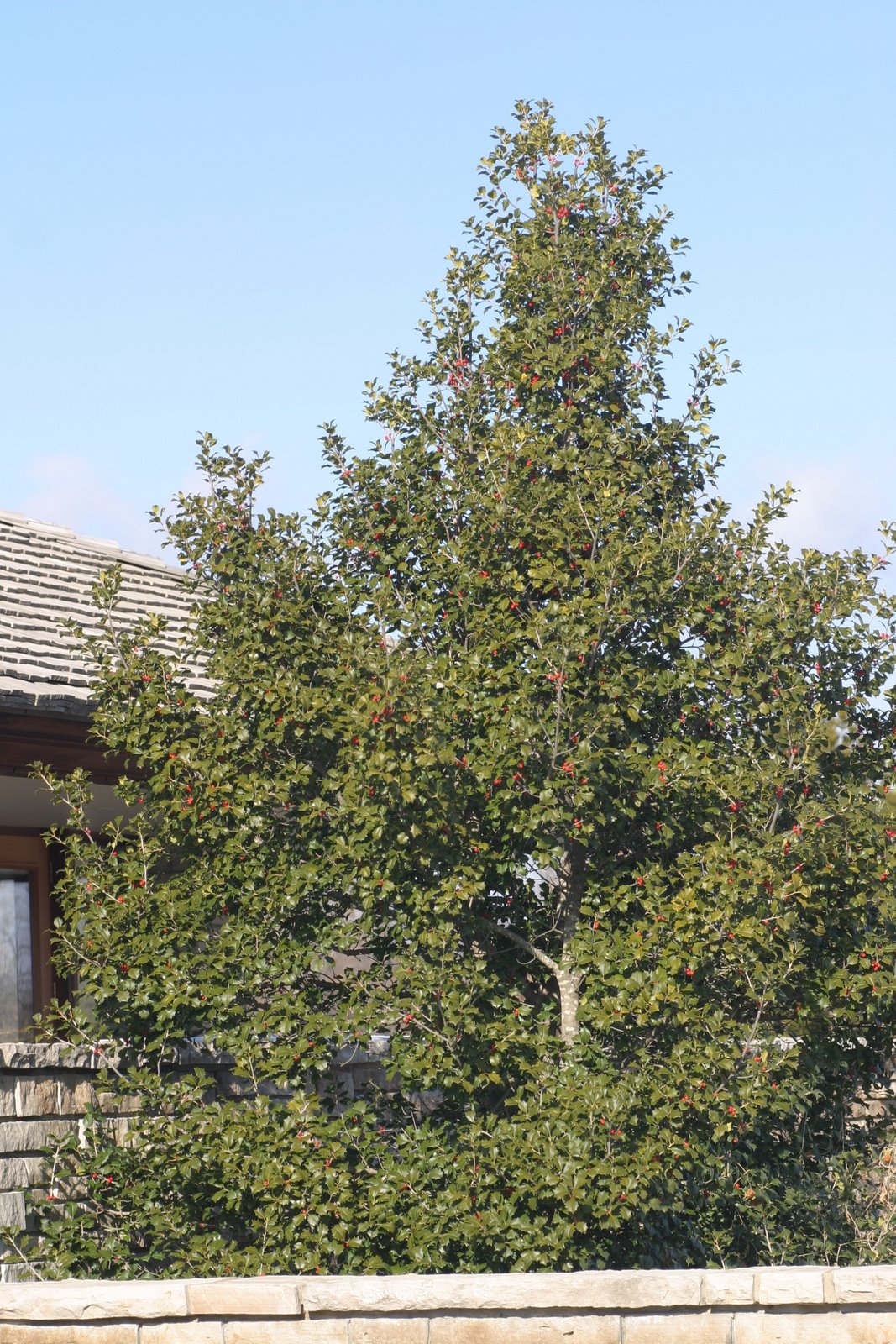
American holly (Ilex opaca)


by MaryAnn Fink

Conservation specialist


copyright 2010


The classic American holly is native to southeastern Missouri.
She is truly one of Missouri’s most beautiful evergreen trees. Her strong upright posture, cheery red berries and spiny leaves create a perfect backdrop for a winter wonderland setting.

Her eventual broad base and her casually irregular shape develops over time. At maturity, these attributes lend an informal, pleasantly relaxed aspect to the landscape. Although her growth rate is considered slow in cultivation, she is dependable and long lived with minimum care.

When she is pruned hard regularly to a defined shape, she can become overstressed and lose some of her appeal. In a preferred setting with deep sandy soil, good drainage and adequate moisture she can potentially reach shade tree status. At a better than fair height of 35-45’ tall, she can carry a significant “wow” factor! If this is the goal, plan for her significant width as well! (Plant for at 10’ base minimum for adequate spacing. If a cultivar or selection is chosen, requirements may differ.

The American holly can be either male or female, but only the female will have berries. Both sexes must be present to ensure fruiting. The fruiting age varies with each tree. Berry production has been reported to occur as early as 3 years and as late as 9 years. The quantity of berries also varies from year to year. Individual tree’s production cycles normally vary from year to year. Also weather conditions, environmental stress and pollinator proximity are factors. Pruning can also decrease or eliminate fruiting as well. Choose trees at time of purchase with at least some fruit if berries are desirable for ornamentation or as food source for birds. Many song birds find holly berries very attractive!

Care Factor Rating: 2-3 This is a naturally steady grower but she does require regular watering year round in order to look and grow her best. Like most evergreens, expect to give her routine care during her establishment period. This is typically at least a minimum of 2 full years and possibly 3 years.

She must be watered regularly till established. Soil testing is recommended before planting to prepare the soil and periodically to be sure iron remains at an available level.
She does tolerate heavy pruning but does not perform her best under those conditions. Given optimal space and conditions and expect optimal results!

If allowed to grow naturally, her “care factor rating drops from 3 to 2 as pruning becomes minimal but her primary need for moisture will continue for the life of the tree for optimal appearance and performance. This makes proper placement critical! She can be very drought tolerant after she has established but is not as likely to look her best.

She is frequently listed as deer resistant however I would say “deer tolerant” is a better description. A well established tree suffering from some visibility issues because of natural pruning can be” prune managed” gently. Heavy and repeated browsing can greatly affect her aesthetic appeal. Fencing and deer repellants are frequently recommended.

By far, the most common cause of yellowing and leaf drop is the loss of older leaves that occurs every spring, just before, and during the development of new growth. So the next time you notice yellow leaves on your holly trees, take a moment to consider the time of year. If it’s springtime, chances are the condition is normal, seasonal and temporary, and no cause for concern.

Extreme winter cold, especially bouts of sub-zero temperatures, can cause yellowing in some years. On rarer occasions any of several leaf-spotting diseases may be the culprit. Their damage is more likely to be cosmetic, rather than life-threatening. More commonly, a lengthy period of drought during the heat of summer can contribute to considerable yellowing and premature loss of leaves.
Newly planted hollies are most vulnerable to drought injury, and should be watered weekly, beginning in early summer and fall. Winter watering will be “as needed” but does require monitoring the soil moisture.

Friday, December 17, 2010

Personal Christmas Message Friends and Family


I do consider myself a “senior” these days and am wearing my graying hair proudly as a sign of the changes that have brought me to this point in my life.

I heard this senior version of the children’s song, “Jesus Loves Me,” read on the Bott Radio station the other day and wanted to share it.
The words brought to mind the challenges we face as we age.

It also caused me to pondered Noah’s story. God “worked” him and blessed him and his family in his senior years.
It made me consider that as I mature, the complexities of knowing God for me at least has become much greater.

A few of my elder friends have been great witnesses. As they have become increasing aware that their days are numbered- I acknowledge so are mine.

Noah’s blessing/ burden was complicated, intense, specific, time oriented and outwardly evident ( it never said anywhere that he hid his ark! So I quit hiding my gray!)
And my favorite part, Noah's blessing was inclusive: Noah’s family benefited from Noah’s rightousness and relationship with God. I have been blessed through my family, especially through my sisters, and especially Joanne, who cradled a little lamb like this in her arms and played this song so many times in her last days. I pray now that God blesses my family in their time of need.

As this celebration of the Holy Night approaches, my prayer is that all my family and my “Family in Christ” is blessed.
Thank you to all who have crossed my path for being any part of my life!
( humm the tune and read the words- oh they are so true!)

JESUS LOVES ME
Jesus loves me, this I know,Though my hair is white as snow.Though my sight is growing dim,Still He bids me trust in Him.

(CHORUS)

Yes, Jesus loves me!Yes, Jesus loves me.Yes, Jesus loves me!The Bible tells me so.
Though my steps are oh, so slow,With my hand in His I’ll goOn through life, let come what may,He’ll be there to lead the way.

(CHORUS)

Though I am no longer young,I have much which He’s begun.Let me serve Christ with a smile,Go with others the extra mile.

(CHORUS)

When the nights are dark and long,In my heart He puts a song.Telling me in words so clear,“Have no fear, for I am near.”

(CHORUS)

When my work on earth is done,And life’s victories have been won.He will take me home above,Then I’ll understand His love

(CHORUS)

I love Jesus , does He know?Have I ever told Him so?Jesus loves to hear me say,That I love Him every day.
(Author unknown)


Thank you also to those who offered verse and web pages for these verses that address my aging issues-I hope I got them right!


I have been young, and now am old; yet have I not seen the righteous forsaken, nor his seed begging bread. Psalm 37:25.


Cast me not off in the time of old age; forsake me not when my strength faileth. Psalm 71:9.
O God, thou hast taught me from my youth: and hitherto have I declared thy wondrous works. Now also when I am old and greyheaded, O God, forsake me not; until I have shewed thy strength unto this generation, and thy power to every one that is to come. Psalm 71: 17-18.


Those that be planted in the house of the LORD shall flourish in the courts of our God. They shall still bring forth fruit in old age; they shall be fat and flourishing; To shew that the LORD is upright: he is my rock, and there is no unrighteousness in him. Psalm 92:13-15.


Both young men, and maidens; old men, and children: Let them praise the name of the LORD: for his name alone is excellent; his glory is above the earth and heaven. Psalm 148: 12-13.


The glory of young men is their strength: and the beauty of old men is the grey head. Proverbs 20:29.


The hoary (silver or grey) head is a crown of glory, if it be found in the way of righteousness. Proverbs 16:31.

Sunday, December 12, 2010

KTRS 550 Inside Out Show Plant of the Week for Saturday December 11 2010


Boxwood 'Green Mountain'


by

MaryAnn Fink

Conservation Specialist

copyright 2010

Thank Goodness 'Green Mountain' Boxwood is an evergreen shrub that can tolerate St. Louis’s weather extremes, at least fairly well!

This boxwood is hardier that many boxwoods currently available. He seems to suffer less from winter burn, stem dieback and insect and disease issues. He also has an even growth habit that helps him recover quickly even if he does suffer some tip burn.

Finally we have a boxwood that seems able to avoid having that stagnant, shrinking, straggly misshaped form that so many older cultivars have eventually develop in the St. Louis area from year after year of heavy pruning management.

Too many boxwoods eventually succumb to VID (Visual Iimpact Decline). This is a condition that develops from the inability for most boxwoods to grow fast enough or evenly enough to compensate from the almost annual removal of winter burned branches and the various degrees of clean up pruning needed for insect infestation control.

To his credit, Bowood ‘Green Mountain’ shows some resistance to these “ills” and issues. His dense branching and slow but even new growth in all directions makes confident clean up pruning possible since the end result is a ‘still attractive” evergreen foundation choice for most if not all year!

His youthful growth rate is comparable to his mature growth rate, fairly slow. This is a benefit once he is installed, but a testimony to the patience of nursery growers.

At time of purchase look for him to already be in a well rounded globe shape. This gives him a pleasant yet classic profile, perfect for holiday lighting ( still with at least a few shoots available for greenery trimming) His well defined ball shape also makes him an easy starter plant for teaching beginning landscapers to “visualize” the base shape and to use it a guide for pruning.

He is also less commonly available in a delightful pyramidal form. Both styles compliment a manicured landscape, however take note he is also able to adapt to a more selective pruning style that eventually reveals his naturally handsome personality! I like to see boxwoods “grown out”. Over time they can become one of the most graceful strikingly handsome shrubs in the landscape.

He grows best in a sunny to partially shaded area protected from wind with evenly moist, well-drained soil. Although his growth habit is slow, it is steady. He shows natural vigor in both upward and spreading directions so with minimal pruning, he has the potential to reach a significant size of 5-7' tall and wide!

Care Factor Rating: 3 This is a naturally compact boxwood that must be watered regularly till established. He does not require heavy pruning and performs his best went given optimal space and conditions. If allowed to grow out pruning care drops to very minimal and his primary need becomes consistant but not heavy, year round watering. He can be very drought tolerant but is not as likely to look his best. He is also somewhat deer resistant, non-invasive and a good protection option from weather and predators for small song birds. A native option with a slightly simular look is inkberry- a personal favorite!

He needs only a gentle hand for clipping to look his best. Although he is generally tolerant of pruning and shearing, it should never be done before the last spring frost date.

Hard pruning late in the summer / fall stimulates growth which is particularly susceptible to winter damage. Pruning too early in the spring also stimulates growth that may be severely damaged or killed by a late spring frost. Wait till spring frosts are no longer a danger and new growth is evident and just do a two step trimming.

The first trim, keep it gentle, trimming only to clean up winter damage and a light shaping. The second trimming can be a slightly harder prune if maintaining a certain size is the goal. Do this second shaping pruning before summer heat- probably best last week of May or first week of June.

The typically performed late summer/ fall trim becomes risky if it is more than a light tipping. Several light trimmings through the season is best. Late season hard pruning sometimes stimulates growth that is easily damaged by weather extremes!

Also be aware that boxwoods naturally have shallow roots that can dry out ANY TIME OF THE YEAR! Water regularly all year and plan to cultivate only lightly near the shrub base . Keep a light layer of bark / compost mulch ( but no more than 1-2”) year round.

Remove dead/damaged branches can be removed any time during the growing season.

Winter winds can remove moisture from leaves at a rapid rate, often resulting in dehydration. Leaf damage is evident by a range of burned appearances. This can range anywhere from a darkening or “bronzing” to a tan dry “toasted” appearance. Whatever doesn’t recover can be removed in the first of the season pruning.

(Also remember to carefully remove any heavy snow accumulations as quickly as practical. Brittle frozen stems are susceptible to stem/branch damage.)

For those interested in B. ‘Green Mountain’s’ background history, his parents are thought to be the sweet little B. sempervirens 'Suffruticosa' (female) a very dwarf compact boxwood and the larger, more manly B. sinica var. insularis (male). B. ‘Green Mountain’ clearly picked up some of the best traits of both his parents.

A few other boxwoods likely to perform well in St. Louis if properly sited are listed below with links:

Buxus semperviren 'Suffruticosa'
Buxus 'Green Velvet'
Buxus sinica var. insularis 'Winter Gem'

Saturday, November 27, 2010

KTRS Inside Out Show Plant of the Week November 27 2010


Happy Holly Days


Ilex x meserveae ‘Castle Spire’


by

MaryAnn Fink

Conservation Specialist

copyright 2010


Castle Spire is a new variety of Ilex x meserveae. This “blue holly” is reported to have good vigor for the extremes of Missouri. Although she was selected especially for her tight dense growth and her narrow upright silhouette, it is her well developed branching that catches the eye. This is a notable improvement for this type of holly!

She has an above average shape formed by her dense branching. She looks natural and balanced as she showcases her bountiful dark foliage. Her forest green complexion accentuates the brightness of her cheery red berries.

It might be tempting to bring her home to be a “one and only” because she will surely slip into even some tight spots with ease. But, resist the urge and instead consider massing her in a staggered grouping. Strategically placed along with a few other “winter showy” performers, she could easily anchor a serene snow-scape. She is pretty enough to be the featured in a living art vignette that would provide the needed structure / “bones” for a year round bird sanctuary!

Her placement is critical for maximum enjoyment! Choose your most visible location for her to be framed by your favorite window. She is furniture rearrangement worthy! Plan for maximum viewing pleasure from a warm and comfy spot!

Care Factor Rating: 1 This naturally narrow compact upright holly must be watered regularly till established. She does not require pruning when given proper space. She appreciates a gentle hand for the only occasional / random shoot trimming! Pruning at any time might affect her berry production!

Bonus tip
Design Suggestion: Consider a beautiful set of triplets in a staggered grouping end-capped with a strong Colorado blue spruce. Like a red Christmas ribbon that weaves through the grouping lace them together with several Red Twig Dogwoods ‘Cardinal’. Back-dropped all of these “pretties” with ‘Red Sprite’ and one ‘Jim Dandy’ deciduous hollies. (Hide him mostly behind the Blue Spruce since he is not so showy!)

Trim out the front edge of this winter fantasy collection with a few evergreen perennials such as Christmas fern. Finally, add a pretty bird bath. For the most wildlife friendly and natural look, consider a year round water feature, such as a phantom fountain that runs all winter with a short bird friendly creek bed!

(Use CASTLE WALL™ somewhere in the landscape as the pollinator for ‘Castle Spire’)

A Few of My Favorite Things (Can you hear me humming tune from Sound of Music?)
Castle Spire Holly Ilex x meserveae (new to me favorite)
Cornus ‘Cardinal’ Red-Twig Dogwood ( Long Time Fav)
Ilex verticillata ‘Red Sprite’ and ‘Jim Dandy’ (Deciduous Holly) (So showy-so easy)
Colorado Blue Spruce. (Picea pungens) (Ahhh)
Bird bath / water feature ( a must for me: always make wildlfe gardening a habit (tat)

Saturday, November 20, 2010

KTRS %%) INside Out Show Plant of the Week Noember 21


Beautyberry

Callicarpa dichotoma is a non-native cousin of our American Beautyberry (Callicarpa americana), qualifying it as another one of my favorite shrubs!

This pretty pastel berried relative has many cultivar names- all with the same common name of beautyberry. It is clear that good looks run in the family and a reminder of how important it is to know botanical names when searching for plants!

This beautyberry is a small stature soft stemmed fountain shaped shrub. She does stay considerably shorter that her native cousin. This is partially because of her thin “oh so nimble” canes that bow to the point of nearly touching the ground when fully burdened with fruit and full leaf.

Her canes, if pruned off at the base and laid out flat on the ground could conceivably be 5’ or longer but because of her relaxed posture, she frequently reaches a growing height under 4' tall. This does mean she extends her width by season’s end. Allow some extra room for her mature full figure. Her cascading fountain shape needs to flex comfortably to look her best!

Summer catches her making a very girly effort to dress up. She sports a repeated series of small Barbie-doll bouquets of lavender rose in her leaf axils all along her wiry stems. These are attractive to butterflies and pollinators! (She is a distant relative of lantana and verbena!)

These flowers then become her “beautyberries. Her gracefully flexed willowy branches flaunt her beaded clusters of amethyst fruit as if she is posing for a “best dressed” red carpet award!

These clusters of pastel purple berries are then chilled to perfection, deepening to vivid violet. This is accentuated first by her “oh so yellow” leaves and then by her tawny bare naked stems. Such a beauty!

These berries typically remain intact for several weeks becoming a song bird treat with minimal mess!

Care Factor Rating: 2 She must be watered regularly until established but after that she is very drought tolerant. She performs best when given a hard pruning to near ground level (leave 3-6” of growth) Do this each spring before leaf bud breaks.

She is a slow to moderate growing cane shrub like many of our best performer. This means she spreads gradually by increasing from the crown / base by producing new shoots from the base annually. This makes her a perfect choice for low hedge or part of a screen grouping. If her individual personality is to remain defined, consider limiting the basal area / spread of this shrub in early spring before the leaves develop. Beautyberry is mostly disease and pest free. Flowering and fruiting are best when several are planted together!

KTRS 550 Inside Out Show Bonus Tip Details How To Water Your Newly Planted Tree


This is my recomendations if you have just planted a decidious tree in the last week. Of course you did water at the time of installtion per my earlier instructions Now, 5-7 days after planting your tree, you will need to establish a moisture checking routine.
I did my "after planting the tree" post planting check after ourt first watering to check to see how well the water had penetrated and dispersed within the tree's root zone.
I recomend doing this within the first 24 hours since the most serious damage to roots after installation happens when the roots of the tree closest to the edge of the root ball dries down too much!
Dry roots can cause signifacant damage. Keep in mind even though there are no leaves present on your tree to use up the water, the water will drain away or be "wick away" as it saturates the surrounding soil. The surface moisture also evaporates- so there are many ways to lose root moisture so don't be surprised if your tree needs water!
In our situation we were very dry before planting so we did a 50 Count initially. We rechecked in 24 hours and did an additional 25 count watering protocal with satisfactory penetration in the root zone. ( the only way to know that is to dig down 6-8" at the mulch edge and feel the soil!)


In a perfect world, it would have been nice to have been watering the entire area all fall a minimum of 1/2-1" of water weekly this would help us balance the mosture needs faster and easier, perhaps with less water)
We are now doing a every 5 day check for the next couple of weeks to get to know our site. If the top 6-8' of the soil around the root ball is dry to the touch- we will water!
As starters we are doing a "75 Count Watering Procedure". This may reduce to 50 or even 25 depending on our weather and percipitation. We recieved less than 1/4" the other night- not enough to even count!
See the instructions below for how is how to do this!


75 Count Watering Procedure:

Counting to 75 slowly with the hose running at a moderate rate.

Starting with the stream of water close to the trunk and water in a gradually widening circle till you have watered all the way to the edge of the tree mulch edge- then reduce the circle of water size till you are back to watering near the trunk again. Do this repeatedly as you count slowly to 75. It should only take 1-2 minutes to moisten the root ball and the surrounding soil. (I prefer to remove the hose nozzel to reduce the water stream force)

Please note you will need to be watering your tree throughout the winter as needed. Also remember to disconnect your hose from your faucet between watering!

(see general guidlines posted earlier )

Sunday, November 14, 2010

KTRS 550 Inside Out Show Bonus Tip Watering Fall Planted Tree


TREE WATERING GUIDE FOR FALL PLANTED TREES

By MaryAnn Fink
Conservation Specialist
Copyright 2010

Water is the most important thing for a new tree. All plants need to be watered for at least the first full year, the first 3 summers and in times of prolong drought.


The following is a suggested guide for how to water a deciduous tree planted in the fall- particularly this fall 2010 which has been so dry! (Deciduous trees are trees that lose their leaves! Typically all leaves have been shed before planting day)

Please note that these are just my guidelines based on a few of Frisella Nursery's suggestions and with my own explainations and recommendations. Adjustments may still have to be made depending on your specific site and soil-check with me via my website if you have any questions.

PLEASE NOTE THAT ALL FALL PLANTED TREES NEED TO BE WATERED BEFORE PLANTING AND AGAIN WITHIN THE FIRST 24 HOURS OF WHEN THEY ARE PLANTED REGARDLESS OF HOW WET THE GROUND.

THIS IS TO REMOVE LARGE AIR VOIDS IN THE SURROUNDING SOIL AND BALANCE THE MOISTURE BETWEEN THE NEW SOIL and SITE AND THE ESTABLISHED ROOT BALL / ZONE.


The time between watering after the initial watering will vary depending on your soil, so checking the trees about every 5-7 days is recommended.

The best way to check is to actually dig down about 8 to 10" along the side of the root ball (or about 8-10” away from the trunk). Check the soil of the root ball at that depth; if wet do not water but go ahead and recheck again the next day,

If dry water the tree again and then keep checking the tree about every 5 days, and if slightly moist check in 7 days again. After several times of checking a schedule develops and you know about how long it takes for your tree to dry.

During the fall, the roots are still active and so still need moisture but the quantity is less than when the tree is leafing out in the spring and during the summer when it is maintaining a full canopy of leaves.

Water is naturally drains or is wicked away by the constantly changing moisture levels in the surrounding soil but the root zone will still need moisture until the roots have extended beyond the original root space. As a tree’s roots develop they become an extensive moisture collecting network. A thriving mature tree can and will compete for available moisture but it takes time to become established!


FALL PLANTING TIME IS September – December! Depends on the amount of rainfall we receive and how long the plants have been in the ground your watering will need to be customized to your site. Generally speaking the time between watering does become more spaced out as we reach the coldest part of winter time.
TIP FOR EVERYBODY: A deep watering in late in fall helps all plants go through winter by protecting them from freezing dry.


WINTER :( December - February) Watering is necessary in this time frame because we have had a dry fall. Also if we have a dry winter (sometimes we are very cold but with little snow!). If that is the case a slow watering on mild days (45 to 50 degrees) will be required!

It is not uncommon for trees planted in heavy clay to occasionally go 2 to 3 weeks between watering, especially in a “wet” fall and winter when rain and snow are plentiful and there are no leaves to be maintained.

(PLEASE ALSO NOTE THAT WATERING PROTOCAL WILL CHANGE IN THE SPRING ESPECIALLY WHEN YOUR NEW TREE IS PUSHING OUT ITS NEW LEAVES AND AGAIN WHEN THE SEASON PROGRESSES. NEVER ASSUME A TREE NEEDS OR DOESN’T NEED WATER ALWAYS CHECK. MANY TREES WILL LOOK WILTED WHEN THEY ARE TOO DRY, TOO WET, OR TOO HOT. DO NOT ASSUME THAT IT NEEDS WATER; YOU WILL HAVE TO DIG DOWN AND CHECK THE SOIL!

PLEASE NOTE: EACH TREE IS DIFFERENT AND EACH INDIVIDUAL TREE MAY USE WATER DIFFERENTLY THEN SURRONDING PLANTS, SPOT WATERING MAY BE NEEDED DURING THE GROWING SEASON FOR THE NEXT FEW YEARS!
Thank you Frisella Nursery's Adan Briagas and Morgan's newly planted Magnolia 'Shiraz' for posing for this snapshot!