Sunday, May 16, 2010

KTRS 550 Inside Out Show Saturday May 15 2010 Featured Plant Details


by MaryAnn Fink
Conservation Specialist
copyright 2010

This native perennial cutie belongs to a large family including T. ohiensis, virginiana, ozarkana, subaspera and ernestiana. All of these are fairly easy to grow plants when used in cultivated spaces that are similar to their natural habitat.

They all have a range of versatility and personality including color variance that is unique to each species and plant. Depending on the specific plant, most have a fairly tidy habit and some have nice foliage though out the season! (Those that decline after flowering respond well when clipped back to ground level. This stimulated new growth that remains attractive the rest of the season!)

My favorite plant currently is residing in the Landmark Gardens / Campus landscape at Alberici Corporate Headquarters, 8800 Page Ave. St. Louis MO. (see image)

This plant is growing in a tough situation- in full sun, no supplemental water and at best average to poor soil (soil tests have not been done to confirm this but the plant community and history of the site gives some evidence to this as a probability)

She has grown well to a mature clump size in the span of approximately 5 years from seed. Unfortunately her exact birthday is not known but assumed, however I plan celebrate this wonderful event with her tomorrow. I will wish her many more as she is a great greeter in this campus’s unique landscape! (I plan to track her performance digitally throughout the year.

I am fairly certain she is of T. ohiensis parentage but will confirm her genotype and source in the course of creating Alberici’s plant library and green space audit record.

The mature size varies with the species and selections and the height can vary especially between species, selections and cultivars.

There is a compact hybrid cultivar ‘Bilberry Ice ‘that is suppose to reach only 6-10” but there are many choices that can reach up as tall as 36”, especially if T. virginiana is in its ancestry.

Most all of the members of the family have similar arching, grass-like foliage that has a significant lengthwise crease that gives it a “recently pressed” appearance

The three petaled flowers are bundled together in casually relaxed clusters. Usually blue but occasionally rose bloom from May into late June and sometimes into July.

She is easily grown in average, dry to medium, well-drained soil in full sun to part shade. She does tolerate light shade but may not produce quite as many flowers. She is drought tolerant once established but looks best when she has adequate moisture before and during flowering. She can handle moist, maybe even slightly soggy situations. This makes her a great candidate for rain gardens.

She is also very tolerant of part shade, but flower production may decrease. Although she can spread from seed in ideal growing conditions, she is easy to recognize, remove and transplant.

Care Factor Rating: 2 This girl is easy to care for. She may only need at most a quick trim following her long period of flowering. Although usually a “close to the ground” clipping is frequently recommended, a sever trimming annually may decrease her vigor over time.

A gentle trimming in mid summer will remove worn foliage, decrease wasted energy on seed production, reduce reseeding and encourage new growth and possibly allow for a repeat bloom in the fall.


ATTENTION: Native spiderwort and "Tropical Spiderwort" is not the same thing! An introduced species Commelina benghalensis, sometimes referred to as "spiderwort", has become an invasive pest in many southern states in the U.S. It is a very difficult plant to control or eliminate from sites once it gets established. It is resistant to Round-Up (glyphosate) herbicide.
Click the icon for a USDA pdf file on this species for more info. Note it has ordinary-looking leaves and native spiderwort has grass-like leaves.
Contact your local plant nursery or extension office for advice on control measures for tropical spiderwort.

Saturday, May 15, 2010

KTRS 550 Inside Out Show PLant of the Week May 15th Spiderwort

by MaryAnn Fink
Conservation Specialist
copyright 2010


Today, on the KTRS Inside Out Show, as the "special agent in charge bringing their listeners great plants", I featured the native perennial Tradescantia, better know as Spiderwort!

I will post tomorrow a plant description which will include this sweetie's many features and care details but right now I would like to answer the question that more than a few listeners have recently asked: Why do you do this? (the show in particular but I get questions about the website and blog as well)

It is a fair question that I ask myself at times when I am feeling faint from lack of oxygen from “speed speaking”. This faint feeling is a repeat side effect following the few minutes I volunteer my time for the show for the “Plant of the Week” segment. I hope and pray that I am successful in being a positive horticulture influence for the show’s many listeners, even if at times I sound maybe too serious or get caught off guard and take up time laughing at these guys.

These two characters, Jim McMillian and John Shea, hosts of the show work very hard to bring the best of their industries to their listeners. I try to do the same because it is a faith calling for me.

I give this information away for free, like the show and this blog because it brings me peace and pleasure. The evidence of God and his promises grows in the garden for me. I am called to share what He has shown me. I have found the Bible and gardening has been a blessing for me and brought me closer to God. I feel he has called me to share this gift of gardening as a personal ministry. I pray daily for gardens, their care takers and all the people involved with helping create blessed opportunities to interface with God’s creations.

Thank you for visiting my website and blog-God bless you!

Be Ever Near Christ Heart-

MaryAnn

Saturday, May 8, 2010

550 Inside Out Show Plant of the Week April 8 2010 Red Buckeye


MaryAnn Fink

Conservation Specialist

Copyright 2010


Q: When is red really “green”?

A: When you are talking about planting the environmentally “Show Me Smart Gardening” choice, Red buckeye to enhance a cultivated green space!


Red buckeye (Aesculus pavia )


Although he is typically included with medium height understory trees, he is usually a rather stout, perhaps even a bit portly fellow.


He is best defined as a multi-stemmed shrub or a low branched small tree. I suppose this grouping of him with slightly larger trees is a little "short" of hopeful. However, with enough elbow room, and the best of circumstances, it is possible to challenge our state champion tree, located near the Jewel Box in St. Louis’s Forest Park. This might be wishful thinking! (So to the optimist- plan for the max and check out the link below!)


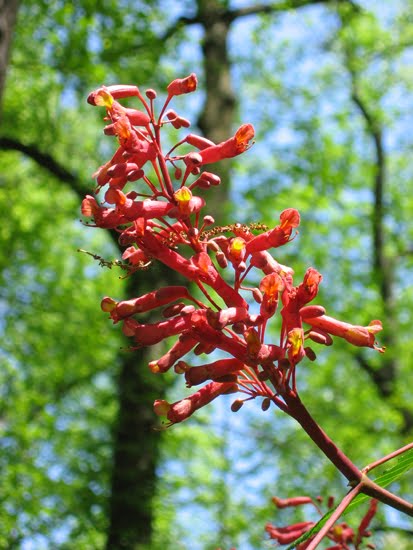
For the more practical, he typically reaches a height of 10-20’. I think it is worth mentioning-he is a bit of a show-off in the spring. Even at a young age (under 3’) he is a talented performer, balancing at his twiggy fingertips 4-10” flower extensions that look more like dozens and dozens of minature pink colored hat racks with multiple hanging rods. Or maybe it looks more like an old fashioned candy store’s lollypop stand (Is it time for sweet tooth break?)


It is on these fleshy short "dowel rod extensions" the rosy tube shaped flowers are suspended. These tubes have a rather novel look. Their blunt tips and double eared protruding petals mixed with a little imagination, looks like hundreds of little pink bunny eared puppets hanging on doll size coat trees. (Well maybe it takes a lot of imagination!)


Although the unique flowers are not otherwise bunny oriented, the Red buckeye is habitat support friendly. He is a great nectar source for the ruby-throated hummingbird!


The Red buckeye’s spring timing is perfect. The hummers are just returning to Missouri from their migration. (Their very first stop is the so sweet Aquilegia canadensis - watch for her first flower to bloom to hang your hummingbird feeder. The red buckeye will sustain while we procrastinate until we see them with our own two eyes ( Stop reading now and hurry to put out your feeder!) Or better yet- call me and let me help you make plans to plant all their favorites! It is easier and prettier and smart too!


These showy flower extensions on the Red buckeye, called panicles, can vary from a reddish pink to a salmon red depending on the specific tree, the weather and the individual flower's age as flowers tend to fade to a pretty pastel. This is lovely when used as a backdrop for the not showy till later / cut me to the ground, Crape myrtle. For another combination idea pair Red buckeye with other early blooming shrubs that also blush tints of pink and peach such as fragrant Viburnums.


The Red buckeye is an under story tree naturally found on wooded slopes, at the base of bluffs and along stream beds. His large dark green leaves, arranged in clusters like the tropical houseplant Schefflera gives him a unique umbrella look and bold texture in the landscape.
He is perfectly happy placed at the edge of a shaded rain garden or along a wet/ dry creek bed. (As long as the soil is not soggy!) He does his best on the outer perimeter but in the shade of larger trees. This is where he can bask in the morning light, flower his best, enjoy good drainage and still escape the afternoon sun. This also makes it easier for him to compete for water rights.
His extra large leaves will dry out and look tattered without some sun protection! ( This can also happen when he is severly water stressed. If this happens, he may decide to save his energy by letting his leaves drop early. He will recover, be none the worse for wear and be "seasonally optimistic" (like me) again the next spring. Take note that repeated environmental stress may slow his growth rate over time and reduce his chance to become a state champion tree!


He does produce the popular smooth brown shiny seeds called buckeyes most seasons. These ripen in the fall. They are poisonous and so are rarely bothered by deer. His fall leaf color is yellow.


Care Factor Rating: 1 Red buckeye (Aesculus pavia) must be watered regularly till established. It is considered best to plant Red buckeye in early spring before flowering, or after flowering is finished but before the summer heat arrives.


Check him frequently for water needs as he establishes. Some leaf drop may occur during transplant transition. To maintain his naturally attractive multi-stem branching habit, minimize any pruning to the removal of only the occasional damaged or dead branch. This can be done any time of the year. Note: Flowering occurs on older wood but starts at a very early age. No regular pruning is needed. Any pruning will interfere with flower and seed production. See the following links for Tree Walk details, and Missouri Department of Conservation information and for a list with links for some other types of buckeyes worth of cultivated green space:


Some of the best buckeye choices for the lower Midwest include:


Aesculus × carnea: Red Horse ChestnutAesculus flava (A. octandra): yellow buckeyeAesculus glabra: Ohio BuckeyeAesculus hippocastanum: Common Horse ChestnutAesculus parviflora: bottlebrush buckeyeAesculus pavia: red buckeyeAesculus × carnea red horse chestnutAesculus pavia var. flavescens: Texas yellow buckeye, yellow woolly buckeye


The most familiar member of the genus worldwide is the Common Horse Chestnut Aesculus hippocastanum, native to a small area of the Balkans in southeast Europe, but widely cultivated throughout the temperate world.


The yellow buckeye Aesculus flava (syn. A. octandra) is also a valuable ornamental tree with yellow flowers, but is less widely planted.


Among the smaller species, the bottlebrush buckeye Aesculus parviflora also makes a very interesting and unusual flowering shrub.


Several other members of the genus are used as ornamentals, and several horticultural hybrids have also been developed, most notably the red Horse Chestnut Aesculus × carnea, a hybrid between A. hippocastanum and A. pavia.

Saturday, April 24, 2010

KTRS 550 Inside Out Show Plant of the Week April 24 2010


Fringe Tree Chionanthus virginicus

MaryAnn Fink,
Conservation Specialist
Copyright 2010

Fringe tree is a stout spring flowering Missouri native tree, commonly called Old Man’s Beard. What many don’t know is he is uncommonly handsome! He rivals any readily available flowering ornamental tree on any lot with his “sigh inspiring” good looks.
Perhaps it is his common name to blame. It is rare to see anyone’s Grandpa or even a realistic Santa Claus clone with facial hair that compares with Fringe tree’s beautiful silken white froth!

He outshines the fanciful collector choices obtained through horticulture’s “catalog candy” shopping and the way too common bread and butters sold in ridiculous quantities during spells of “asphalt fever”. (See warning below)

He does have some interesting habits and notables. He preferred to be maintained as a multistemed specimen. His posture is casual with a rounded shoulders profile and low branches that offer just enough shrug to let you know he is easy going and congenial even in less than best circumstances. In flower, his sweetness pleases more than the eye. His fragrance is light, not overpowering and wonderfully fresh.

He is capable even in his youth of supporting a frothy mass of fragrant white flowers. In nature he is found mixing it up in low moist woods particularly near stream banks. He is most noticeable in spring dotting sunny hillsides or balancing precariously on rocky ledges. Birds seem to relish the fall fruit that develops on the hard to find female trees. They are usually sparsely present and partially hidden by the yellowing foliage.

His natural range which extends from southern New Jersey and southeastern Pennsylvania south to Florida, and westward to Texas shows he is both attractive and functional. A choice companion for sites with “issues” especially landscapes needing erosion control and rain gardens needing structure!

Care Rating: 1 He seldom needs any type of pruning, and requires minimal water once established (though he looks better, flowers more and seems to produce and hold more leaves when not drought stressed repeatedly.) Although extended drought or extreme dry conditions will effect his performance, he does "tolerate" less than perfect sites and air pollution. He is likely to adapts to city life with ease- just don’t leave him thirsty all the time. Watch for scale and borers particularly if he is grown in dry locations!

(Uncommon Rant-If you are sensitive about where you shop or your plant knowledge- call for help and don't continue reading- just know I am here and willing to offer advice.)
Warning: Asphalt Fever: This type of spring fever can be contagious! It is usually caught in the crowd flow when passing through parking lots of discount stores filled with florist plants, heat intolerant annuals and spring flowering trees and shrubs.

The fever emerges annually with the bloom of forsythia, is rampant by the time dogwoods bloom and peaks in late spring. It is virtually uncontrollable, resulting in bouts of purchase frenzy. CURRENTLY NO IMMUNIZATION IS AVAILABLE!

Best preventative practice includes strong doses of shopping advice from local reputable nursery professionals. They are familiar with fever, understand its effects and although they themselves are not immune, they can offer preventative advice that can temper and help manage the unnecessary side effects of the fever, most notably the resulting unfortunate landscape!

Additional cautionary measures: Buyer bewares! Although there is always new strains (not really) detected, the sickness is frequently the same. It causes impulsive purchases that victimizing young and elderly home owners and horticulturally “weak” land managers.

The fever’s after-effects are frequently permanent, resulting in investment loss, buyer’s remorse when the poor quality is realized and low product survivability- the landscape can be forever compromised!
The part that grieves me the most is when I get reports that the so called " hypnotic " flowers have fallen off, usually within a week of planting. This usually happens just as the fever subsides. The victims do have spells of nausea when they realize that all the dedicated space and the work/ time spent for only a week or two of flowers. There are also occasional reports of unexplainable and sometimes reoccurring memories and prayerful vigilance held while waiting (forever) for a repeat performance!

Sunday, April 11, 2010

KTRS 550 Inside Out Show Special Edition April 11 2010 Dogged by Dogwood Failures


Lost Dog (wood)
or Misssouri Dogwoods “dogged” by failure problems

( or how about this-read it like a news headline)

DOG (WOOD) RATHER DIE THAN BE TAMED!

OR (As I recall a beautiful one in a seemingly wrong place between a Bob Evan restaurant and a Drury Inn)
DOG (wood) GONE GOOD (! Or ? ) Which a question or an exclamation, I can’t decide?

Perhaps then I should go with: Dogwood Dilemma, since I am trying to stress the important connection between site and success. Yet always there to impress and haunt me, is the unexplainable, occasional, thriving, seemingly perfect Flowering Dogwood speciemen in someone’s backwoods or even their front yard! I may as well admit- I have both a headache and the ahhh feeling- oh the wonder of it all!

(Readers -pick your favorite article title and I will amend accordingly!)

Horticulturaly speaking, Flowering Dogwood (Cornus florida) is reported to “do best” in evenly moist but not soggy, slightly acidic soil with morning sun and lightly filtered afternoon shade.
(However when reading site information to avoid dreaded diseases- full sun is sometimes recommended-humm!)
Either way what is most clear to me is there are some fairly specific needs that need to be met in order to have a successful Flowering Dogwood. I doubt any tree book or professional article would read- “Flowering Dogwood- easy, adaptable to wide range of light, growing conditions and soils- no health or pest problems” at least that that doesn’t seem to be true.

Here is a quick quiz: What do these places have in common?

The compacted subsoil of new construction lots
poorly drained parking lot medians,
polution-filled roadsides
public parks with minimal staff and no way to provide supplemental water in drought periods,
Concrete planting pits, possibly the nightmare of the future!
Boulevards with low obstruction intolerance
Aging alleyways that appear to be nearly abandoned except for the trash can patrol
Wind tunnel walkways located on “inspired” commercial campus,
Air conditioner screening opportunity
In the path of mow and blow crews that lack horticulture concern AND steering abilities
and last but not least a very green “brownfield redevelopment site”

ANSWER: Places Dogwoods have died!
More politly said- The common denominator for these locations is that they are "not suitable"
"promising " or “best ever” Dogwood planting sites!

Here are a few frequently given reasons for “Dogwood failure”(translated means: dead dogwoods)

“planted where exposed to intense heat sources” ie: adjacent to parking lots / air conditioner units etc.
“low salinity tolerance"
“Mechanical damage “(mower or weed trimmer damage on the trunk )
“Construction site/ compressed root zone” ie: roots damage
"Transplant shock" three days, one month, two months, six months etc!

Here is my favorite failure report description that no one should ever want to hear: “Trees appears to be weak. Possibly suffering from multiple diseases including possible Dogwood anthracnose / Scorch. All trees in various stages of complete decline-recommend removal.”(oowch)

I suggest to both homeowners and land managers who have taken a fancy to this beautiful native tree, get to know and appreciate the potential for its loss ( unofficial rumor is that some years in Missouri there has been as high as 50% failure/ loss for first year transplants ) Since hearing this, I always take time to marvel when I see a Cornus florida thriving and in full flower- another ahhhhh!

Recommendations: Request to see your favorite Nursery’s Missouri nursery inspection certificate, Discuss your warranty in detail before purchasing a dogwood tree including replacement policy and seasonal availability. Following your purchase, keep your receipt and make a point of keeping communication lines open with your Nursery Manager. Some problems are not problems at all, a few are correctable and every conversation is a learning opportunity.

Hire only Certified Arborist to care for your trees. Become familiar with the Dogwood’s most common problems and if you decide to go ahead with planting- especially if there is multiple groupings of trees, ask me to help you put together a "care plan" that includes inspecting and logging the “current condition” of the trees- This should be done frequently, even weekly during the peak heat and stress periods.

Final Word: Answer to your questions- Yes I love Dogwoods-Yes I am monitoring and recording several dogwoods currently under my care. Yes I would plant one if I was as confident as possible about placement and all the other issues because –they are the most beautiful wildlife habitat choices in the right place!

Helpful Links:
Common Dogwood questions
More questions and answers
Dogwood Diseases
Dogwood Anthracnose

More about Dogwoods

Tuesday, April 6, 2010

550 KTRS Inside Out Show Spring Break Plant of the DAY April 6 2010


Tropical Blue Plumbago

If you love blue flowers and butterflies, then Blue Plumbago is for you!
This big boy has good vigor, high color impact and great humidity tolerance. This makes the challenge to find the right spot for his lax stems, worth the effort- especially when they are loaded with flowers!

His best use maybe isn’t in the typical hanging baskets, though that is frequently the way you can purchase him (though it does make my heart skip a beat when I look up at the flowers and the sky and, well I feel like I can touch heaven!)

He is able to stand our heat, but not so much so when the water is limited to just what a basket can hold. He does ask for a commitment-he requires daily watering! (forgetting this means more than hurting his feelings- he stops bringing you flowers opps -I hear a song “you don’t bring me flowers-anymore- sad moment remembered, favorite POP person of the past, funny phone messages- bring a smile )

Perhaps I did best when I accepted that he (meaning this tropical lover) is who he is- a seasonal plant, just here for the summer. I try to make this one of my BMP-PP (Best Management Practices for Plants and People) It takes practice to accept someone for who they are, but it ends up better for everyone.

In the plant world that means really knowing and caring where a plant came from, what he likes, what he needs. Once I accepted him and let him “do his thing” in the ground- I enjoyed him even more and without much regret! (I always wanted to keep everything- but unfortunately- no greenhouse! I use to dream about having a rental greenhouse house where people brought their “keepers” for the winter, I would care for them, love them all winter long and give them back each spring. Later I decided most tropicals don’t love back so much in the winter and they get sick and then what if no one came back to get them and they were abandoned- oh no!)

Back to Plumbago (or Blue Boy as I affectionately call him)
After returning from visiting my landscape architect relative in Hawaii, (yes talent runs in the family- but he is on my husband’s side) This is where I really fell in love- he (Blue Boy) was this most handsome informal hedge border that wrapped around my cousins’ personal garden-He was breathtaking!)

When I returned home I planted my Blue Plumbago in the ground and ever after made purchasing and planting Plumbago as an annual tradition and memory plant of that wonderful trip.
I also have to admit, I don’t think I had any idea of what a grand butterfly magnet this “blue phlox “was either, but I learned! Thank heavens (see he makes you think like that-with all that blue) I placed him where I could sit near him and enjoy his many “attractive “qualities! I had so many butterflies that year!

To keep this tropical beauty “attractive” (in flower) plan for “special time” / regular grooming. Each pruning session seems to stimulate another growth flush and more flowers- as long as there is adequate moisture and nutrients in the soil. (He confirmed another of my BMP-PP beliefs, choose to spend quality time, you usually will get something more in return- in this case flowers!)

He is native to South Africa, in places where the soil is slightly acidic, so if he does struggle with yellowish foliage, there maybe a need manganese. Wait and see if this becomes a problem before adding anything to the soil as you may be fortunate not to need it. You can throw your soil “off balance”, even with a “balanced” fertilizer if you add fertilizers willy –nilly!

Saturday, April 3, 2010

KTRS 550 Inside Out Show Spring Break April 3 Show Me Smart Watering Tips


A Few Smart Water Wise Tips for Missouri:


Combines beauty and function with Missouri –friendly plants that thrive on efficient water use! Here are a few very basic principles of eco-smart landscaping for your garden:


1. Select plants for your region and local situation. Dry areas are perfect for less-than-thirsty plants. Match moisture lovers to low spots, swales and dry creek / storm water runoff areas. Consider turf as an accent for your garden. Treat it like a plant, chose the best type of grass, grow it well and mow it at a height that supports and cools good deep roots- For most grasses, that means setting your mower high as possible, to at the least 3” high.


2. Group plants carefully and consider trees, shrubs, ground covers, perennials and annuals for your garden. Learn about what grows together naturally in the same or similar plant communities and be sure they require about the same amount of water.


3. Use water as a resource not a waste product. This means pay attention to your plants need for water instead of by timers or calendars. Plants in flowers require more water than when they are not flowering. Water stress reduces flowering! Always monitor your water application to avoid runoff and overspray. Better to turn off too soon than to overwater!


4. Loosen your soil. Routinely cultivate it, incorporating reasonable amounts of organic matter such as compost. Annually! Doing so improves the soil’s ability to resist evaporation and retain moisture. Be careful when aerating heavy or compacted soil around trees!


5. Mulch. A maximum of two- to three -inch layer of mulch evens out temperature extremes, keep soil cool on hot days and warm on cool days. It needs raking and fluffing monthly to prevent crusting, this allows better air and water penetration. Take a cue from nature and choose one of many organic mulches that add great visual texture to your landscape, such as shredded bark or chips, wood grindings, or compost. Even low-growing ground cover can be used but remember-it doesn’t know your limits! You set the the boundaries! Inorganic mulches, such as gravel or rock, especially with barrier cloth create pearched water situations, compact the soil and hold heat. Ocassionally gravel is appropriate for use with plants susceptible to crown rot.


6. PLANT TREES! Trees help to lower air and soil temperatures, reducing plant and soil moisture loss. They do drink a lot of water- but they give back to the environment so much more!


Join me at Oma’s Barn April 7th for First of my Walk and Talk-Bloom and Groom Sereis- call for Lisa for details- it is free and everyone is welcome!